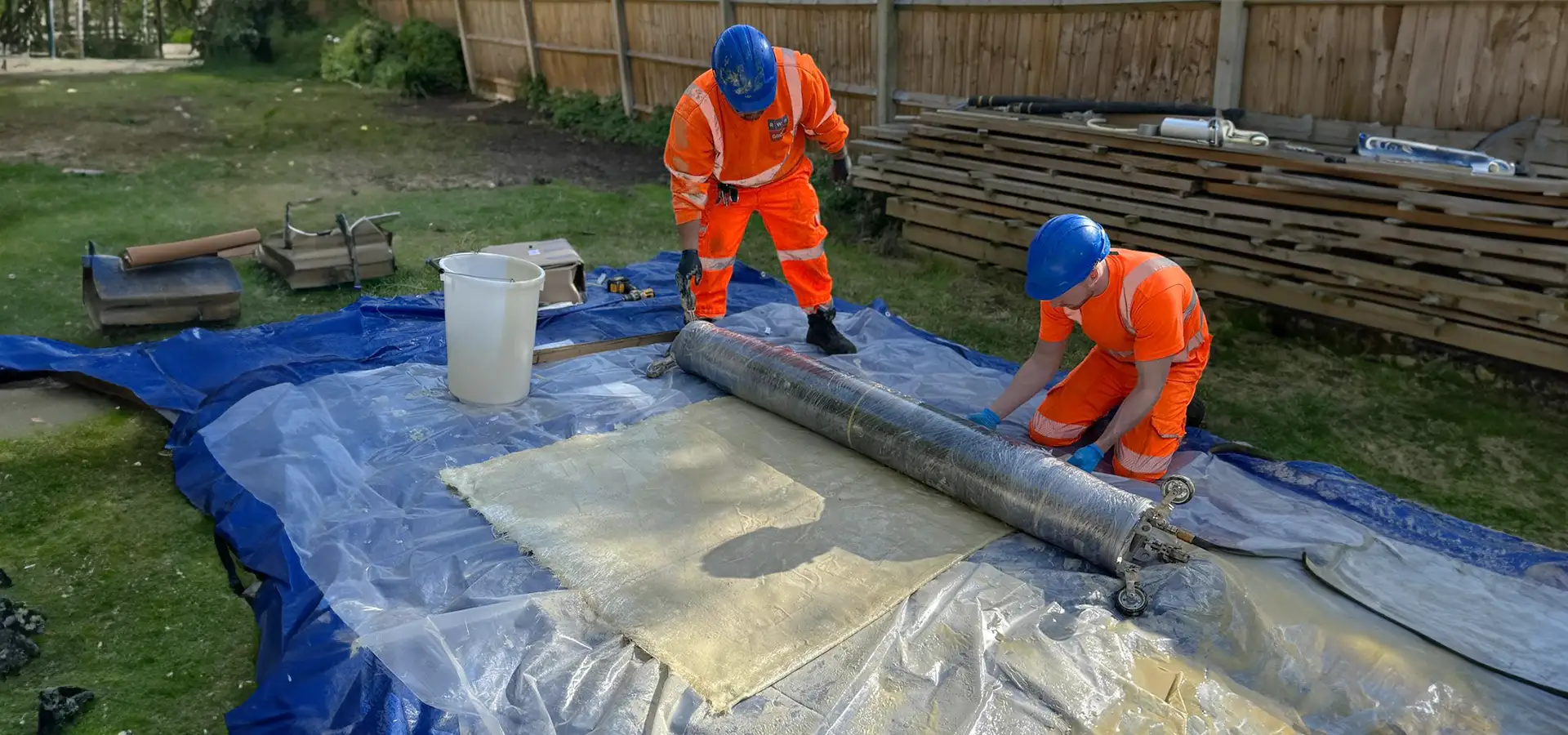
Slip Lining: How It Works and When to Use It
Slip lining is a trenchless rehabilitation method in which a new, smaller pipe is inserted into a deteriorated host pipe and the gap between them is grouted. It is one of the simplest ways to restore a sewer, culvert or pressure main without open-cut excavation, but it trades some internal diameter for that simplicity. This guide explains how it works, where it fits alongside CIPP and other no-dig methods, and what an asset owner should check before specifying it.
How Slip Lining Works
Survey. The host pipe is inspected by CCTV (or sonar/ROV where it is surcharged) to confirm its line, level, defects and any obstructions.
Clean and prepare. Roots, encrustation and debris are removed by jetting and robotic cutting, and the pipe is gauged to prove the liner will pass.
Insert the liner. A new pipe, typically polyethylene (PE/HDPE), GRP or PVC, is pulled or pushed in through a manhole or a short launch pit.
Grout the annulus. The space between host and liner is filled with grout to lock the liner in place and transfer load.
Reconnect and test. Lateral connections are reopened, the system is tested, and a post-installation CCTV survey records the finished asset.
Types of Slip Lining
Continuous slip lining. A long, fusion-welded PE string is pulled in from one pit. Fast, with few joints, but needs space for the string to be laid out.
Segmental slip lining. Short sections are jointed in the manhole or pit and pushed in. Suits large-diameter sewers and culverts and constrained urban sites.
Close-fit lining. A PE pipe is temporarily reduced in diameter (swagelining or fold-and-form), inserted, then reverts to fit tightly against the host, minimising the loss of bore.
Slip Lining vs CIPP and Other No-Dig Options
| Method | Best suited to | Main trade-off |
|---|---|---|
| Slip lining | Long straight runs, culverts, pressure mains, where some loss of diameter is acceptable | Reduced bore; launch pit often needed; laterals must be reopened |
| UV / CIPP lining | Gravity sewers and drains with bends and laterals | Requires good cleaning and controlled curing |
| Patch and mechanical repairs | Isolated cracks, joint failures and localised defects | Not a full-length structural renewal |
| Top-hat lateral sealing | Leaking or root-infested lateral connections | Addresses connections only |
Design Checks Before You Specify
Hydraulic capacity. A smoother liner can partly offset the smaller bore, but the reduced diameter must still carry design flows, including any climate change allowance on peak rainfall for surface water and combined systems.
Structural condition. Is the host pipe partially or fully deteriorated? That determines whether the liner and grout must carry ground and traffic loads on their own. Our structural condition auditing service grades the asset to recognised condition codes.
Line and level. Deformation, offsets and sags restrict the liner size that will pass.
Connections. Count and locate every lateral before design; each needs reinstating and sealing.
Access and permits. Pit locations, traffic management, consents for work in watercourses or culverts, and confined space controls for any man-entry work.
Frequently Asked Questions
Is Slip Lining Structural?
Yes, when the liner and grouted annulus are designed for the full ground and live loads. That design should be based on a current condition survey.
How Much Flow Capacity Is Lost?
It depends on the liner size and wall thickness relative to the host pipe. Close-fit methods lose the least. A hydraulic check should be part of the design.
Can Culverts Be Slip Lined?
Often, yes. Culverts are frequently straight and large enough for segmental lining, but the reduced waterway area must be checked against flood risk.
Get the Right Repair for the Asset
Civil Connect Subsurface Solutions inspects, cleans and rehabilitates sewers, drains and culverts for utilities, highway authorities, rail and contractors. We start with the survey and recommend the repair method that suits the asset. See culvert rehabilitation, contact our team or call 0208 387 5591.
Talk to a specialist
Need Expert Support with Your Drainage or Subsurface Assets?
From surveys and mapping to trenchless repairs and 24/7 response, our engineers deliver nationwide.

